Messolonghi
Cartes Postales from GreeceMessolonghi is a low-lying town on a strategically important stretch of the Greek landscape, defined in the narrative by both its precarious relationship with water and its burden of historical memory. It is closely associated with Lord Byron, but the town’s story is not simply the story of a celebrated English visitor: its memorials also recall the courage and losses of the people who lived through the siege and the Exodus of Messolonghi. For the traveling narrator, time spent there brings those histories into conversation with private loneliness and disappointment.
Setting and Place in the Journey
The narrator approaches Messolonghi after a stay in Kalavrita and Diakofto, crossing from the Peloponnese toward Central Greece by way of the suspension bridge at Rio. The route places the town within a journey shaped by landscapes and historical associations. Messolonghi itself initially disappoints as a picturesque destination, but its setting gradually commands attention: it lies so low that it seems almost below the water, with towering mountains rising immediately behind it. Its position is both visually dramatic and strategically important.
The town’s geography is also described as precarious. In the historical account embedded in the narrative, Messolonghi appears as a fishing settlement barely above sea level, surrounded by marshy land and vulnerable to flooding. Streets can become swamps in the rainy season, and the town seems at risk of being cut off or swallowed by the surrounding waters. That physical vulnerability gives the place a distinctive character: it is not a polished postcard scene, but a settlement whose terrain seems bound up with exposure and survival.
Byron and the Town’s Historical Memory
Messolonghi holds Greece’s closest association with Lord Byron, and the narrator encounters signs of how extensively he is remembered. Streets and squares bearing his name appear across the country, and the narrator understands the scale of this commemoration as a form of hero worship. Yet local memory is more complicated than a simple story of a foreign hero liberating Greece. Byron did not fight in the Greek War of Independence; his importance lay in inspiring people abroad to support the Greek struggle against Ottoman rule. The narrator is interested in the gap between his symbolic stature and what he actually did.
That tension becomes tangible in the town’s museum and memorial garden. The museum occupies an old mansion affected by the town’s damp climate, so the paintings on display are copies rather than vulnerable originals. Among them is a reproduction of Delacroix’s image of Greece amid the ruins of Messolonghi, which moves the narrator even in its faded form. The picture gives the town’s suffering a larger political frame: Messolonghi stands for the violence of invasion and the national struggle for freedom. In the nearby memorial garden, an idealized statue of Byron looks, to the narrator, less like a triumphant hero than a dejected child.
A municipal worker encountered at the memorial garden challenges the popular version of Byron’s role. He emphasizes that ordinary people’s resistance to the Turks is too often overlooked, and that Byron died before the eventual end of Ottoman rule. The exchange sharpens the narrator’s question about why Byron remains a hero in Greek memory. It does not erase his importance, but it distinguishes influence and inspiration from direct military action.
The Exodus and the Embedded Past
The town’s most devastating historical association in the narrative is the Exodus of Messolonghi. In 1826, two years after Byron’s death, the town was besieged for a third time and its population attempted to break out. Thousands were killed. The narrator connects this history to the town’s continuing public mourning: Messolonghi is presented as a place whose past has not become safely remote, even as its memorials preserve the event for later visitors.
The narrative marks a transition from the traveler’s present-day visit into an account identified as an eyewitness narrative from 1824. That shift gives the town’s history a different narrative scale: Messolonghi is no longer only a destination inspected by a visitor, but a setting entered through testimony from an earlier period. The contrast between the modern journey and the embedded historical account makes the town’s layered time part of its meaning. The museum, memorial garden, and landscape are encountered in the present, while the historical narrative recalls a community facing siege and danger.
Winter Stay and Narrative Significance
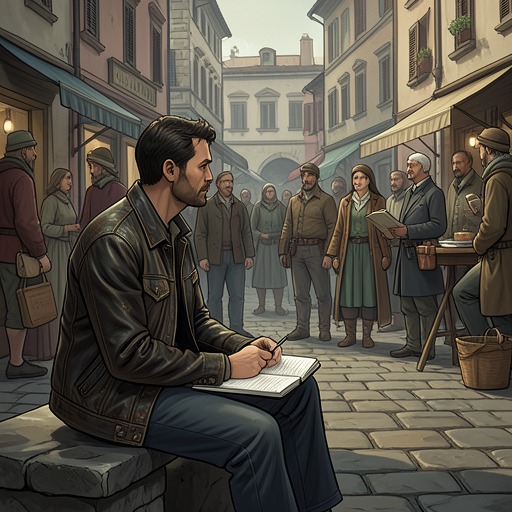
Messolonghi also becomes the setting for an extended, solitary stay. The narrator’s hotel is a large, neglected building dating from the Greek military dictatorship period, with only a small fraction of its rooms occupied. The narrator moves the desk beside the balcony windows to write while looking toward the sea. Though the towels are rough and the sheets gray, the hotel’s quiet suits the work; a lighted model ship in reception provides its modest Christmas decoration. On Christmas Day, hearing family life over a call to a brother makes the narrator feel isolated enough to consider abandoning the journey and returning home.
That difficult moment belongs to a broader change in the traveler’s outlook. In Messolonghi, reading about Byron leads the narrator away from fascination with his charisma and toward pity for his unhappiness and unreturned love. His story becomes a lens through which the narrator considers the pain of rejection, while the town’s memorial history offers a separate, more public account of loss. The two are not treated as equivalent: the narrator distinguishes personal heartbreak from the suffering remembered at Kalavrita and in Messolonghi. Instead, the place allows private grief and historical memory to coexist without collapsing into one another.
The town also complicates the Greece first imagined through postcards. Before traveling, the narrator pinned the cards into a bright blue-and-white mosaic and wondered whether their light and beauty reflected reality. Messolonghi’s damp museum, austere memorials, and unpicturesque lowland setting offer a different kind of encounter: less scenic than historically charged. Its importance in the narrative lies precisely in this contrast. It makes the journey not merely a search for attractive places, but an education in how landscape, hospitality, memory, and personal feeling shape what a place can mean.